
Transforming Web Interactions with AI: Beyond the Usual Use Cases
TL;DR
The article discusses the potential of AI, especially Language Learning Models (LLMs), to transform web interactions in ways that go beyond common use cases like chatbots and content creation. It outlines the limitations of traditional web and app experiences, which often require manual inputs, and explains how chat-based AI can streamline tasks by interpreting user intent and automating processes. The piece highlights the versatility of conversational AI, which can function across different platforms, from messaging apps to voice assistants, making online interactions faster and more intuitive. The article urges businesses to adopt LLM-powered solutions to improve user experiences and simplify digital operations.
The discussion surrounding artificial intelligence (AI) and Language Learning Models (LLM) and their applications over the past year has been extensive and exhausting, with much of the discussion circling around the same few points. These include LLM clients like ChatGPT and Gemini’s ability to improve automated customer care through chatbots, the ability to generate content and high quality visuals quickly, and the efficiency gains in tasks like drafting emails, building websites or formatting data. While these applications are certainly valuable, one area that has so far been underexplored is the potential for language models and chat-based AI to transform the user experience on the web fundamentally. This blog will dive into how these technologies can redefine the way we interact with the internet.
How Web Interactions Have Evolved and Where They’re Headed Next
Since the internet’s inception, user interactions have primarily been facilitated by browsers, which translate difficult to read computer code into user-friendly web experiences. With the rise of mobile devices, apps added another method of accessing the internet, blending the user’s physical attributes and the mobile device’s tools such as cameras, fingerprint recognition, etc. to further improve the user experience. However, despite these advancements, the fundamental internet experience has remained largely the same for the past two decades, with the bulk of the responsibility for producing inputs that backend code can understand still sitting with the user.
Today, the process of purchasing products, signing up for accounts, or navigating websites still demands considerable effort. Even with improvements like single sign-on options, the user is still required to type, click, and input information in specific formats. These steps serve to help the backend systems interpret user intent correctly, but they also add friction to the user experience.
Conversational AI: Lifting the input burden from users
AI-powered chat interactions, particularly those using language models like GPT, have the potential to revolutionize the web by changing how users interact with digital services. Instead of navigating through pages and forms, users can communicate their needs directly, and the AI can understand and act on those instructions. This shifts the burden of formatting and data entry from the user to the AI, streamlining the entire process.
For instance, current web forms require users to fill in their name, address, email, and other details separately. With AI, a user could simply provide all this information in a single message, and the system would parse it into the required fields and in its required formats (think how many different ways you’ve had to input your phone number in your lifetime). The AI can distinguish between a name, an address, or a phone number based on context, making the interaction more seamless and intuitive.
Real-World AI Implementation: How Spaceship Uses “Alf” to Enhance User Experience
A notable example of this technology in action is Spaceship’s recently introduced support client, Alf (which it dubs its “AI Assistant”). Its CEO Richard Kirkendall recently announced it had entered Beta. Spaceship is a provider of domain names, hosting, SSLs, DNS services, etc. and have launched Alf as a chat-based AI that goes beyond basic customer support functions by taking certain actions on the user’s behalf. If a user wants to change a name server record as an example, the chat client can understand the request and execute the command through a connection to the backend systems.
Previously, such changes would require multiple steps: logging in to the Spaceship account, navigating through settings, and entering information manually in the input fields provided. The user would then have to troubleshoot any mistakes they made along the way, possibly interacting with the support team for help. With Alf, users can simply state what they need, and the AI handles the rest, minimizing the need for back-and-forth communication or manual input. This automation represents a significant leap forward in simplifying user tasks and making interactions more efficient.
The Power of Conversational Interfaces: Beyond Websites and Apps
What makes chat-based AI particularly exciting is its ability to operate independently of traditional web or app interfaces. Conversations can take place over various platforms, whether on a website, through messaging apps like WhatsApp, or even via voice assistants like Alexa. As voice recognition technology continues to improve, the possibility of handling these interactions verbally becomes more feasible, enabling users to make requests and complete tasks without ever opening a web browser. Imagine washing dishes at your kitchen sink and asking Alexa to renew your domain name, all without having to take off your washing up gloves. This is all within reach and with far less effort than was required a year ago.
This is also great news for businesses as it could means there is no longer a need for complicated and expensive developments of separate apps for each platform or device. Instead, a single chat client, that a business integrates to interact with the different platforms and devices, can be designed to understand user requests and interact with the business’ backend systems, drastically reducing development costs and simplifying the integration process.
Redefining User Experience: From Cumbersome to Seamless
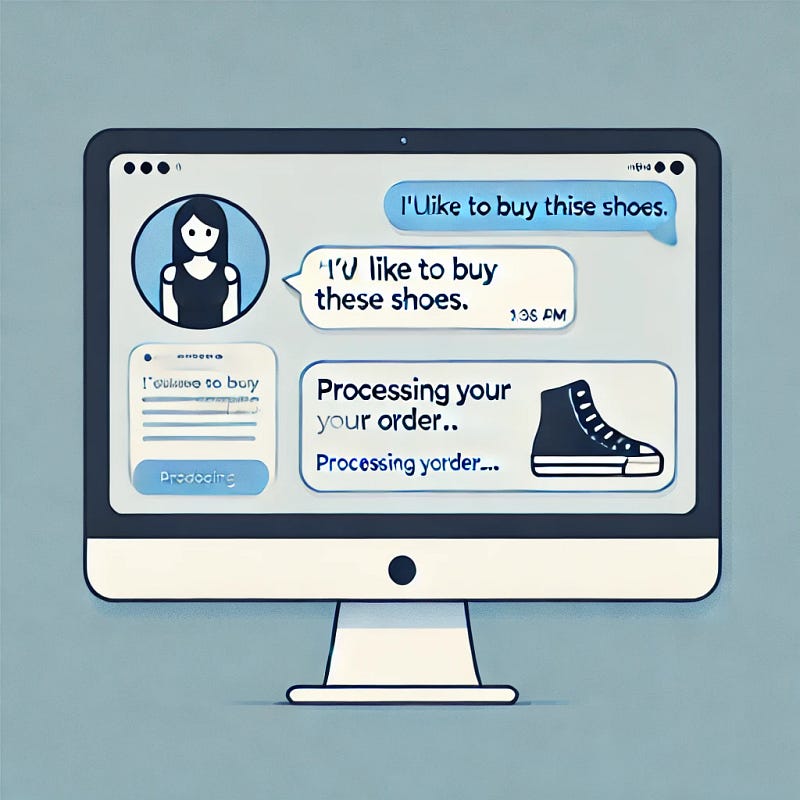
Currently, online shopping and other web-based interactions involve a series of cumbersome steps, especially for first-time users. Even with tools like password managers and saved payment methods, setting up an account and making a purchase can feel tedious. Having a conversation is a very natural action for most humans. Imagine instead simply telling a chat client, “I’d like to buy these shoes and have them sent to my address, here is my address and credit card information” with the LLM-powered chat client then taking care of setting up the account, processing payment, and completing the transaction by parsing the information and sending it to the backend via API.
This is the direction where AI-powered chat interfaces can take the user experience. By making use of the incredible and unprecedented power of LLMs to interpret user intent, these models can remove the burden of a user to interact with, and input data into, a website or app in a way that the backend understands. The potential applications extend beyond e-commerce to include any task that involves data entry or user decision making.
A Practical Use Case: Subscription Renewals
An excellent example of where chat-based AI can shine is in managing renewals for the domain industry, where most domains need to be renewed annually. Here an LLM-powered client could send a simple reminder message through the user’s preferred chat method like: “Your domain is up for renewal. Would you like to renew it?” The user could respond with a simple “yes” or “no”, or even “please wait until tomorrow as that is payday” and the LLM-powered client could interpret the user request and schedule the backend command automatically, removing the need for the user to go to a website or click a link in an email.
For companies looking to get started, focusing on simple “Yes/No” tasks like subscription renewals are a great place to start, but there are undoubtedly countless simple improvements in user experience to be made.
Conclusion
The potential for AI to transform web experiences goes far beyond generating content or automating customer service chatbots. Businesses with relatively simple product offerings are best placed to get the quickest return from connecting an LLM-powered client to their backend. The key lies in using AI to understand user intent and parse data, removing this burden from the user and automating tasks that traditionally required manual intervention.
As AI continues to advance, the way we navigate the web could soon look very different from what we’ve grown accustomed to over the past 20 years. The time to start building this future is now.